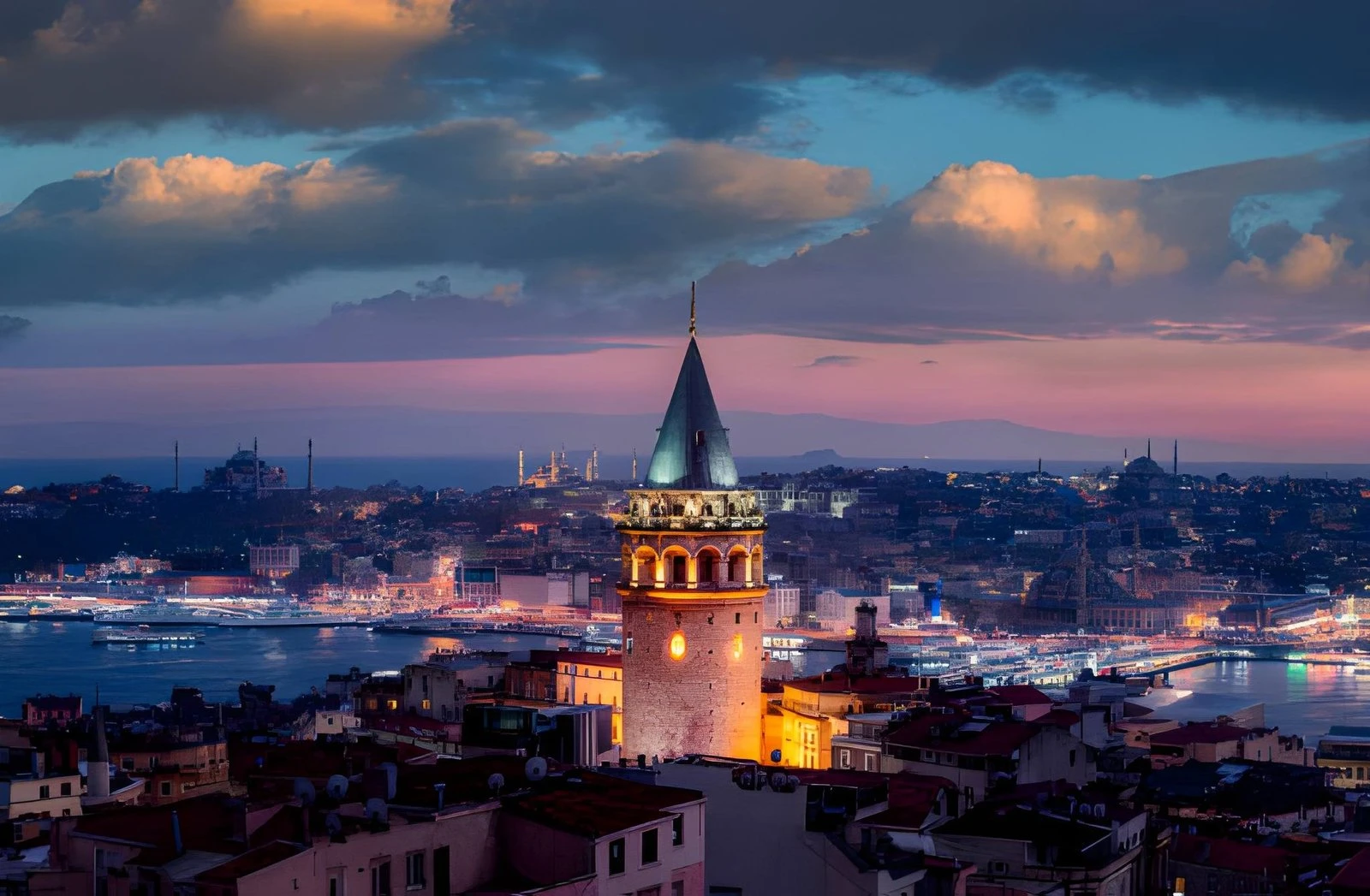
An honest guide to Galata Tower: its Genoese history, whether the 30-euro climb is worth it in 2026, what to identify from the viewing balcony, and how to walk down via the Kamondo Stairs to the cafés of Karaköy.
## The tower that has watched over Istanbul for seven centuries
There is an experiment we run with almost every traveler: we ask them to point out Galata Tower from Galata Bridge. Nobody fails. With its 67 meters of stone crowned by a conical roof, the tower has dominated the Beyoğlu hill since 1348 and is, together with Hagia Sophia, the most recognizable silhouette in Istanbul. What almost nobody knows is that the full experience is not only up on the viewing balcony: it is also down in the streets of Galata and Karaköy that surround it.
Most guides you will find online stick to three facts: price, opening hours and "go at sunset". This guide does something different. We tell you the real Genoese history of the tower, we give you an honest answer to whether the climb is worth what it costs, and we walk you downhill through a neighborhood most cruise passengers and day-trippers never set foot in: the Kamondo Stairs, the old Ottoman financial district and the cafés of Karaköy.
## From Byzantine lighthouse to Christea Turris: the Genoese legacy
Chronicles mention a first lighthouse tower on this shore as early as 528 AD, in the time of Justinian. But the tower you see today is not Byzantine: it is Genoese. In the 14th century, Genoa controlled Galata (then called Pera) as a walled trading colony, a small republic of Italian merchants facing Constantinople. In 1348 they raised this tower as the crowning piece of their fortifications and named it Christea Turris, the Tower of Christ. It was the highest point of the walls, commanding all maritime traffic on the Golden Horn.
When Mehmed II conquered Constantinople in 1453, the Genoese surrendered Galata without resistance and the tower passed intact into Ottoman hands. The following centuries gave it roles few visitors imagine: prison, astronomical observatory and, from 1717, a fire-watch tower. The irony is cruel: the tower dedicated to spotting fires burned itself in the great blazes of 1794 and 1831, and lost its conical roof in a storm in 1875. The cone you see today was restored in the 1960s following old engravings, and the latest full restoration, completed in 2020, turned the interior into an official museum.
## Hezarfen and the flight across the Bosphorus in 1632
If the tower has a founding legend, this is it. According to the chronicles of the Ottoman traveler Evliya Çelebi, around 1632 an inventor named Hezarfen Ahmed Çelebi launched himself from the top of Galata Tower wearing artificial wings of his own design and glided over the Bosphorus, landing in Doğancılar Square in Üsküdar, on the Asian shore: a flight of more than three kilometers. Sultan Murad IV, who watched the feat, first rewarded him with a purse of gold and then, uneasy about a man capable of such a thing, exiled him to Algeria.
Did it happen exactly like that? Historians argue over every detail, because the only source is Evliya Çelebi, famous for embellishing his tales. But the story is so powerful that Hezarfen gives his name to an Istanbul airfield today, and when you stand on the balcony looking toward Üsküdar you will understand why this legend has been told for four centuries: the distance commands respect even for a modern drone.
## Is the climb worth it? 2026 prices and the honest answer
Let's get straight to the numbers. In 2026 the ticket for foreign visitors costs 30 euros per person; children under 7 enter free upon showing their original passport. General hours run 8:30 to 23:00 from April to October and 8:30 to 22:00 from November to March, with last entry one hour before closing. An elevator takes you to the seventh floor and the last two levels are climbed by spiral staircase; the outdoor balcony is narrow and circled shoulder to shoulder at busy times.
Our honest answer as guides: the climb is worth it if you go right at opening (8:30-9:30), when morning light hits the historic peninsula and the queue takes minutes, or on a clear winter day. It is not worth it at sunset in high season: the line can exceed 45 minutes, the balcony packs solid, and the photo you came for will be taken by fifty phones pressed against yours. And if you travel on a budget, here is something few guides admit: the best view OF the tower is free from below, and several café rooftops in Karaköy offer comparable panoramas for the price of a Turkish tea.
## The view from 67 meters: what to identify on the horizon
The balcony offers a true 360 degrees, and knowing what you are looking at multiplies the experience. Facing south across the Golden Horn, the historic peninsula lines up: Süleymaniye Mosque on its hill (Sinan's masterpiece), and further east the Sultanahmet trio, with Hagia Sophia, the Blue Mosque and the pavilions of Topkapı Palace peeking through the cypresses. Directly below sits Galata Bridge with its permanent line of rod fishermen.
Facing east, the mouth of the Bosphorus opens up: the Maiden's Tower on its islet, ferries crossing to Üsküdar and Kadıköy, and cargo ships waiting their turn to enter the strait. On clear days, toward the southeast, the Princes' Islands float on the Marmara. A photographer's trick: in the morning the sun sits behind you when you shoot the historic peninsula; at sunset the opposite happens and the best light shifts to the Bosphorus side.
## Karaköy on foot: the Kamondo Stairs and the district reborn
Here begins the part of this guide you will not find on ticket-selling websites. From the tower exit, walk down Galata Kulesi Street toward the water. In three minutes you reach the hidden jewel of the neighborhood: the Kamondo Stairs, commissioned in 1860 by the banker Abraham Salomon Kamondo. Their interlaced Art Nouveau curves are not an aesthetic whim: family legend says he designed them so his grandchildren could never tumble down more than one flight. It is one of the most photographed corners of Istanbul and still usually half empty.
The stairs spill onto Bankalar Caddesi, the Street of Banks: the Wall Street of the Ottoman Empire in the 19th century. Its most imposing building, the former Imperial Ottoman Bank, is today SALT Galata, a cultural center with free entry, a monumental library, exhibitions and a little-known upper terrace overlooking the Golden Horn. Five minutes away stand two temples that condense the neighborhood's history: the Arab Mosque (Arap Camii), once the Genoese church of San Domenico, its bell tower now a minaret, and the Underground Mosque (Yeraltı Camii), carved into the vaults of an old fortress by the port. The whole walk, unhurried, takes between ninety minutes and two hours.
## Where to eat in Karaköy: from baklava to third-wave coffee
In a single decade Karaköy went from a port district of hardware shops to the informal food capital of the European shore, and the mix is still alive. The mandatory stop is Karaköy Güllüoğlu, a temple of baklava since 1949: order the classic pistachio with tea and watch the local ritual of eating it with knife and fork. For something savory, the flaky böreks from the neighborhood bakeries work as breakfast or a quick lunch for a few liras.
The inner lanes (Mumhane, Kemankeş and around) concentrate the third-wave coffee scene that made the district famous: in-house roasters, serious baristas and tiny storefronts. If you climb back toward the tower along Serdar-ı Ekrem Street you will find Turkish designers' boutiques in 19th-century buildings. A local tip: avoid eating on the square immediately around the tower, where prices are postcard-tourist level; two streets downhill you eat better for less.
## From your cruise ship: the tower and Karaköy on a Galataport call
If you arrive in Istanbul by cruise, this is your zone: Galataport, the terminal opened in 2021, sits literally at the foot of the Galata hill. From the ship to the base of the tower is an uphill walk of about 15 minutes, passing the İstanbul Modern museum designed by Renzo Piano. A half-call plan that works beautifully: tower right at opening, down the Kamondo Stairs, SALT Galata, lunch in Karaköy and back along the Galataport promenade with time to spare.
If you would rather use your port call to also cross to the historic peninsula with a guide who manages your ship's schedule, our [private shore excursion from Galataport](/en/tours/istanbul-shore-excursion-galataport) picks you up at the terminal itself, adapts the route to your exact cruise hours and returns you on board with a guaranteed margin.
## Quick questions about Galata Tower
**How much time do I need for the visit?** Between 45 and 75 minutes in total: queue, the museum floors and the balcony. Right at opening it can drop to half an hour.
**Can I buy tickets online?** Yes, through Turkey's official museum ticketing system, which saves you the box-office line though not the elevator queue. In high season it is strongly recommended.
**Is there an elevator to the top?** The elevator reaches the seventh floor; the last two levels are a narrow spiral staircase. The outdoor balcony is not wheelchair accessible.
**What is the best time to go up?** Opening time (8:30) for morning light and minimal queues, or one hour before sunset on low-season weekdays. Summer sunset is the single most crowded moment of the day.
**Do city tours include the tower?** Our [2-day](/en/tours/istanbul-highlights-2-days) and [3-day](/en/tours/istanbul-highlights-3-days) itineraries include the Galata and Karaköy neighborhood with a guide; the balcony climb is left as optional free time for those who want it, precisely for the queue reasons explained above.
**Where is the best photo OF the tower taken?** Three spots: the corner of Büyük Hendek Caddesi (the classic shot with the street framing the tower), Galata Bridge at sunset, and the Karaköy-Kadıköy ferry, which hands you the full panorama of the hill for the price of a public transport token.
## Climb the tower and walk down Karaköy with a private guide
Climbing a tower is easy; understanding seven centuries of Genoa, fires, Sephardic bankers and legendary flights while you walk the neighborhood is something else. Alfombra Voladora Travel is a Turkish agency registered with TÜRSAB under license A-9759, operating the Istanbul Private Tours brand with state-licensed guides and private chauffeured vehicles. The Galata and Karaköy district is part of our [2-day Istanbul Highlights](/en/tours/istanbul-highlights-2-days) and the [3-day version with the Bosphorus](/en/tours/istanbul-highlights-3-days), and it is the heart of our [shore excursion for cruise passengers](/en/tours/istanbul-shore-excursion-galataport). Write to us on WhatsApp (+90 546 559 25 00) or at info@istanbulprivatetours.com at least 24 hours ahead and we will tailor the visit to you.
And if Istanbul is just the start of your trip, we help you work out how many days to see Turkey you need.