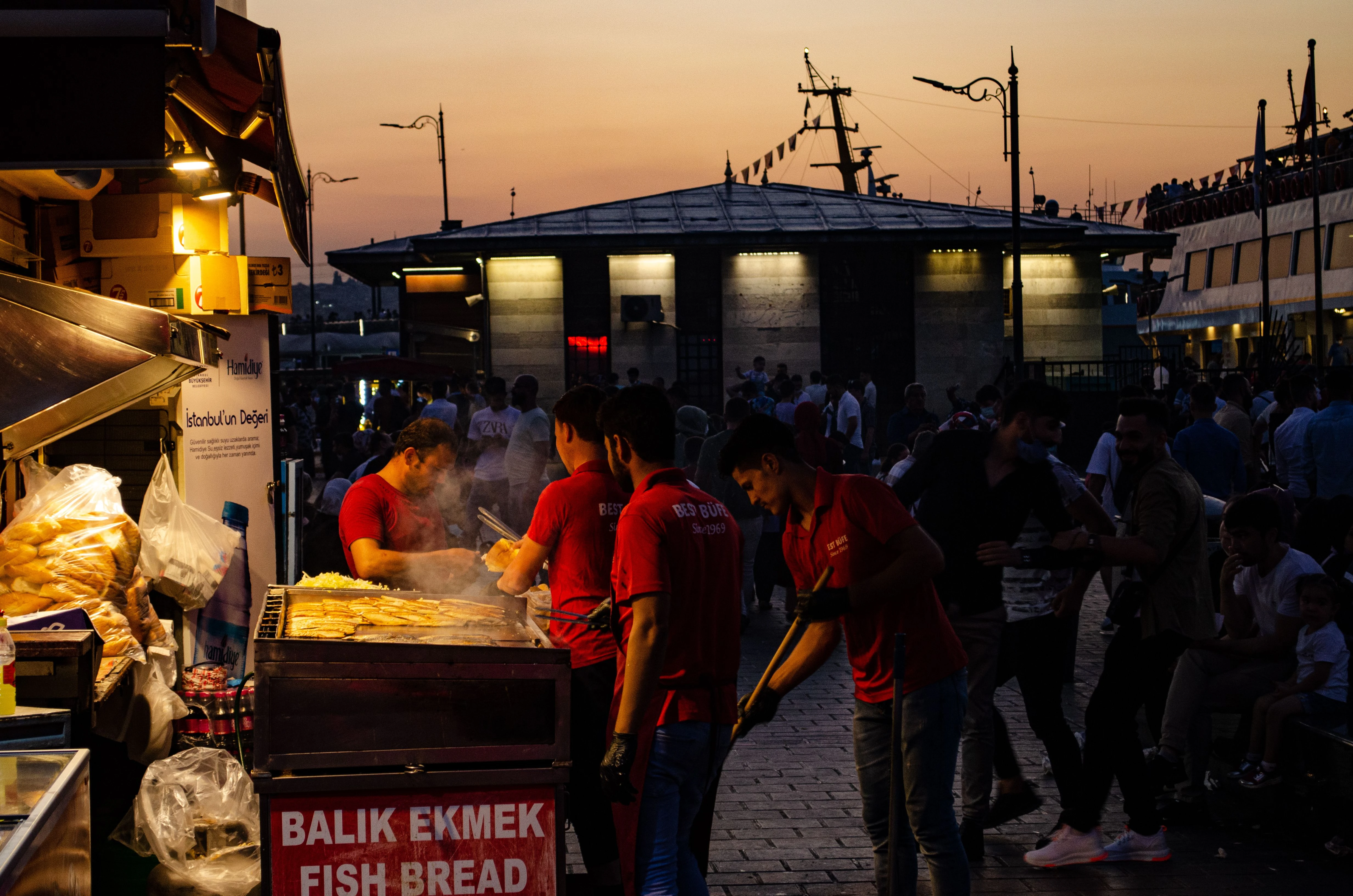
The twelve dishes that explain Istanbul, organized the way the city eats them: Turkish breakfast, the street, the meze table and the sweet ceremony. With specific neighborhoods, tourist traps flagged and answers for vegetarians.
## Twelve dishes and one golden rule
People come to Istanbul for mosques and palaces, but they go home talking about food. The city has spent five hundred years cooking for an empire that ran from the Balkans to Baghdad, and that inheritance shows on every corner: the same alley can smell of fresh sesame bread, meat roasting on a vertical spit and melted butter over cheese. The traveler's problem is not finding somewhere to eat: it is choosing among ten thousand options without landing in the watered-down tourist version.
This guide organizes the twelve essential dishes not as a flat list but the way the city actually eats them: what is eaten at breakfast, what is eaten standing in the street, what is shared at the table and what closes the day with coffee. And before we start, the golden rule we repeat to every traveler: eat where locals queue and the menu has no photos. It works one hundred percent of the time.
## Turkish breakfast: simit, menemen and the çay ritual
The traveler's first discovery is that breakfast here is a genre of its own. The simit (dish 1) is the crunchy sesame-crusted bread ring you will see on red carts in every square from seven in the morning: warm, fresh from the neighborhood oven, it costs pennies and is the national commuter breakfast. The full version is menemen (dish 2): eggs slowly scrambled with tomato, green pepper and sometimes cheese, served still bubbling in a two-handled pan. You eat it by dipping bread, never in a hurry.
All of it is washed down with çay (dish 3, because here tea counts as food): black, strong, served in tulip glasses that get refilled without your asking. Turkey drinks more tea per person than any country on earth, ahead of every Asian powerhouse, and refusing an offered glass borders on discourtesy. The full weekend Turkish breakfast — cheeses, olives, honey with kaymak, eggs, börek — deserves an entire morning of your itinerary.
## Midday on the street: döner, lahmacun and balık ekmek
The street is Istanbul's second dining room. The döner (dish 4) is the original from which every kebab in Europe descends: ribbons of lamb or chicken carved off the vertical cylinder, served in bread or over rice. The life-changing version is the İskender, invented in Bursa: döner over chopped bread, tomato sauce, yogurt and melted butter poured at the table.
Lahmacun (dish 5) is Anatolia's answer to pizza: paper-thin dough baked with spiced minced meat, rolled up with parsley and lemon and eaten by hand in three minutes. And balık ekmek (dish 6) is the Galata Bridge institution: grilled mackerel inside half a loaf with onion and lettuce, eaten facing the water it was fished from. Local honesty: quality varies by stall and by day; if the mackerel does not smell of fresh charcoal, walk twenty meters to the next one.
## The table you share: meze, pide and köfte
A serious Turkish dinner begins with meze (dish 7): the constellation of cold and warm starters — yogurt haydari, spicy ezme, smoked eggplant, stuffed vine leaves — that covers the table before any main course appears. In the meyhane (traditional taverns) of Beyoğlu, the waiter comes around with the tray and you choose by pointing. It is the city's social institution: the two-hour dinner existed here centuries before it became fashionable elsewhere.
Pide (dish 8) is the boat-shaped baked dough filled with cheese, minced meat or sucuk (Turkish spiced sausage), cut crosswise into strips: the dish a cold day's lunch asks for. And köfte (dish 9), the flattened charcoal-grilled lamb-and-beef meatball, is the measure of any Turkish home kitchen: served with rice, onion salad dusted with sumac and a roasted green chili. The historic köfte houses of the old city have served exactly the same plate for generations, and that is precisely the guarantee.
## The sweet and the ceremonial: baklava, künefe and Turkish coffee
Baklava (dish 10) deserves that you forget everything you tasted outside Turkey: forty layers of filo, Gaziantep pistachio and just-right syrup, sold by weight and eaten with knife and fork. Künefe (dish 11) is the hot grand finale: kadayıf strands crisped in butter with melting cheese inside and ground pistachio on top, served straight from the oven; ordering it "with kaymak" (buffalo cream) is the expert move.
And the obligatory close is Turkish coffee (dish 12), UNESCO Intangible Cultural Heritage since 2013: ground to powder, brewed slowly in a copper cezve and served grounds-in, which are left to settle and then — among friends — read to tell your fortune. You state the sugar when ordering (sade unsweetened, orta medium, şekerli sweet), because it is cooked with the coffee, not stirred in afterwards.
## Eating near the monuments without falling into the trap
Let us be blunt: the three-hundred-meter radius around Sultanahmet Square concentrates the worst value-for-money in all of Turkey. The alarm signals are universal: backlit photo menus, a greeter-tout at the door, a menu in eight languages and the word "authentic" repeated three times. Ten minutes on foot, in the Sirkeci streets toward the Egyptian Bazaar or the back lanes of Hocapaşa, prices halve and the cooking doubles.
That is why our guided routes build food into the itinerary: on the [half-day old city tour](/en/tours/half-day-old-city-tour) the guide points you to where the Grand Bazaar merchants eat, not where the bus groups are parked. And if you arrive by cruise with counted hours, the [shore excursion from Galataport](/en/tours/istanbul-shore-excursion-galataport) leaves room for a real lunch in Karaköy, five minutes from the ship and a world away from the port-side offer.
## Kadıköy: the Asian shore for serious appetites
If food is a priority of your trip, cross the strait. The Kadıköy market on the Asian shore is the favorite gastronomic territory of Istanbulites themselves: fishmongers who cook what you pick, pickles served in a glass with their brine, the historic meatball houses of the market street and the city's best concentration of patisseries and coffee roasters per square meter.
Kadıköy rarely fits a weekend dash, so we include it where it makes sense: the [3-day itinerary](/en/tours/istanbul-highlights-3-days) gives the Asian shore half a day with the ferry ride included, while the [2-day version](/en/tours/istanbul-highlights-2-days) concentrates the culinary firepower on Karaköy and the Egyptian Bazaar. In both cases the guide eats with you: the best guarantee the table will be one of the good ones.
## Vegetarians, allergies and other table questions
Turkish cuisine is kinder to vegetarians than it looks: the zeytinyağlı tradition (vegetables cooked in olive oil, served cool), legume mezes, menemen, cheese-and-spinach böreks and eggplant in all its forms make complete meat-free meals. The key word is "etsiz" (without meat); in meyhanes, half the meze tray is typically vegetarian by default.
For allergy sufferers: nuts are everywhere (pistachio in sweets, walnuts in sauces), so the phrase "fındık ve fıstık alerjim var" (I am allergic to hazelnuts and pistachios) is worth carrying written down. Gluten is harder to dodge — bread is religion — but meat and fish grills with salad work. As for tap water: locals drink bottled, do the same.
## Quick questions about eating in Istanbul
**How much does it cost to eat well?** A full street lunch (döner or lahmacun plus ayran) costs a fraction of any European capital; a meyhane dinner with generous meze sits at mid-European range. The tourist trap charges Champs-Élysées prices for microwaved food: avoiding it is the single biggest budget optimization of your trip.
**Do you tip?** In sit-down restaurants, 5-10% in cash is customary and appreciated. At street stalls, it is not expected.
**Can I drink alcohol with dinner?** In licensed meyhanes and restaurants, yes: rakı (Turkish anise spirit) with fish is in fact a national ritual. Conservative areas and simple eateries may not serve it; no offense taken in asking.
**What happens during Ramadan?** Tourist restaurants run normally. Neighborhood places may close by day and fill at dusk for iftar; sharing an iftar table is actually a memorable experience if your trip coincides.
**Are water and salads safe?** Bottled water always. Salads at established restaurants are fine; cart fruit, peel it yourself.
**Turkish breakfast or hotel breakfast?** If your hotel is international, escape at least one morning to a local breakfast salon. It is the difference between a buffet and a culture.
## The city makes more sense with your mouth full
You can memorize Ottoman dynasties, but you will understand Istanbul faster biting into a warm simit facing the Bosphorus. Alfombra Voladora Travel — a Turkish agency, TÜRSAB license A-9759, behind the Istanbul Private Tours brand — designs its routes with food inside them, not as a footnote: from the merchants' lunch on the [half-day old city tour](/en/tours/half-day-old-city-tour) to the Karaköy table on the [cruise shore excursion](/en/tours/istanbul-shore-excursion-galataport), through the full [two-day](/en/tours/istanbul-highlights-2-days) and [three-day](/en/tours/istanbul-highlights-3-days) itineraries. Tell us what you love to eat on WhatsApp (+90 546 559 25 00) or at info@istanbulprivatetours.com and the guide adjusts the stops: 24 hours' notice is all we need.
Beyond Istanbul, plan your Turkey circuit to keep discovering the country's food and landscapes.