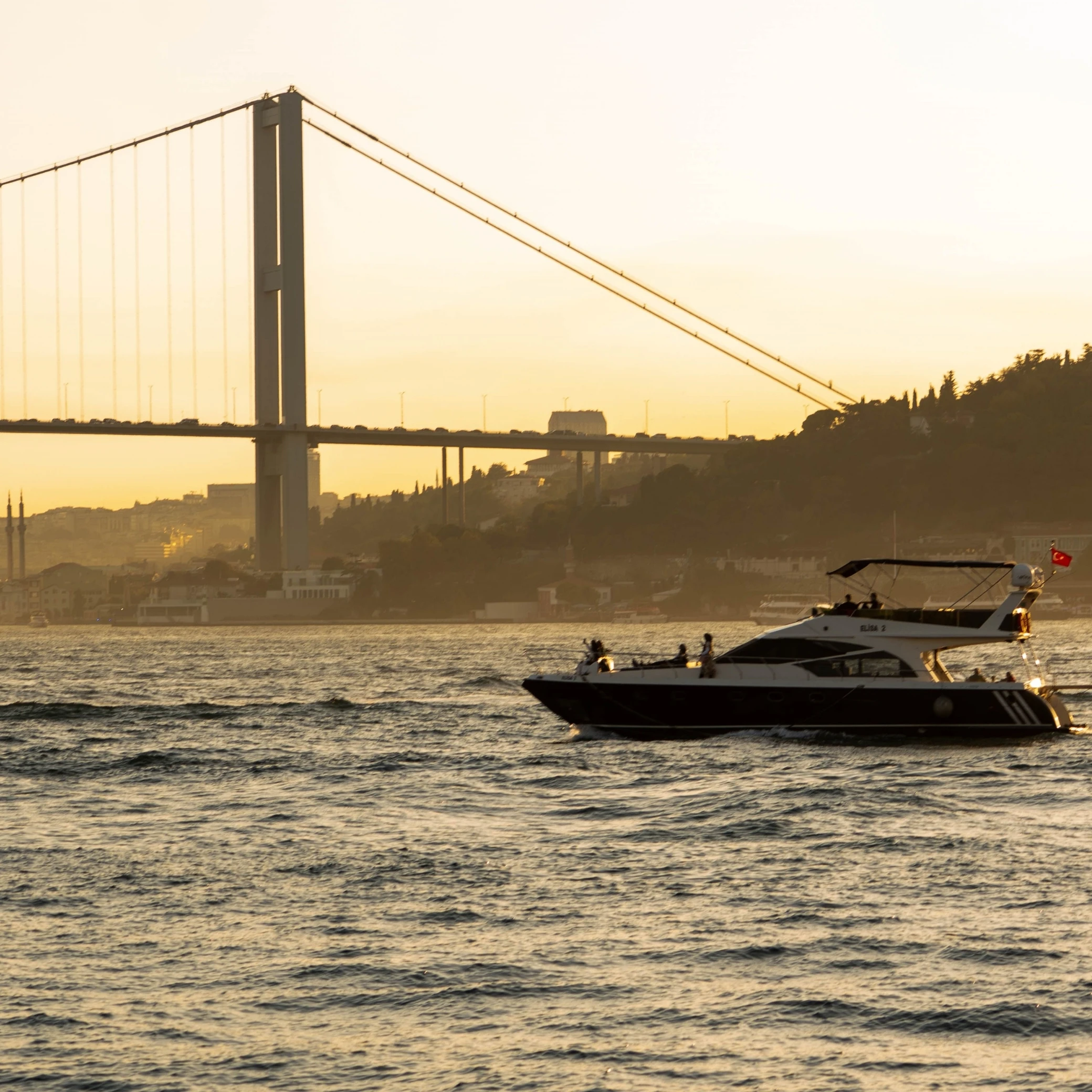
What you actually see sailing the Bosphorus: the palaces of the European shore, the fortresses that decided the conquest, the world's most expensive wooden mansions, and an honest comparison of public ferry, tourist boat and private yacht.
## A strait between two continents
There is exactly one place in the world where a city embraces two continents, and you are picturing it right: it is here. The Bosphorus runs some 31 kilometers between the Sea of Marmara and the Black Sea, separates Europe from Asia, and at its narrowest point measures barely 700 meters. Above it stretch three suspension bridges; beneath it, a railway tunnel; and across its surface, every single day, an unending choreography of freighters, commuter ferries, fishing boats and yachts.
Sailing it is not just another Istanbul activity: it is the only way to grasp the geography that explains three empires. From the water, the city rearranges itself. Palaces hidden behind walls when seen from land appear head-on, full façade, exactly as they were designed to be seen: from the sultan's boat. This guide tells you what you will see shore by shore, what legends its towers carry and, first of all, which kind of boat suits your trip.
## Public ferry, tourist boat or private yacht: the unfiltered comparison
Let us be the first article to tell you plainly. There are three ways to sail the Bosphorus and none of them is "the best" for everyone.
The public ferry of the city lines is by far the cheapest option: for the price of a transit token you cross from Europe to Asia among local commuters. Its limit is obvious: fixed commuter routes, no narration, shared benches and zero flexibility. It is transport, not a visit.
The large-capacity tourist boat (the one- or two-hour cruises leaving from Eminönü) is very affordable and covers the classic route. In exchange: hundreds of passengers, loudspeakers in several languages at once, a fight for the good railing spot and rigid schedules. If it is your first time and budget rules, it does the job.
The private yacht plays in another league: a boat for your group only (in our case up to 12 guests), a professional captain, a roughly two-hour route that adapts to the light and your rhythm, and a free deck to move around and shoot photos without strangers' heads in the frame. It is the choice for couples, families and groups who want the strait to themselves. Our [2-hour Bosphorus Yacht Discovery](/en/tours/bosphorus-yacht-discovery) is exactly this format.
## The European shore: from Dolmabahçe to Rumeli Fortress
Sailing north, the European shore opens the parade with Dolmabahçe Palace, completed in 1856: 600 meters of neoclassical façade at the water's edge and fourteen tonnes of gold leaf on its ceilings. Atatürk died here on 10 November 1938 at 9:05, and every clock in the palace still shows that hour. A few minutes later comes Çırağan Palace, a former imperial residence turned luxury hotel, its marble façade restored after decades in ruins following a fire.
The next postcard is the most photographed on the strait: Ortaköy Mosque (1856), a neo-Baroque jewel planted on the quay, framed by the July 15 Martyrs Bridge (1973), the first to join the two continents. That 19th-century dome under 20th-century steel is the image that defines the modern Bosphorus. Further north, past the mansions of Arnavutköy and the café terraces of Bebek, rises the mass that changed history: Rumeli Hisarı, the fortress Mehmed II raised in 1452 in barely four months to cut Constantinople's Black Sea supply line. A year later, the city was Ottoman. Seen from the water, its three towers stepping down the hillside, it makes more sense than in any book.
## The Asian shore: Beylerbeyi, Kuzguncuk and the other Istanbul
The return along the Asian shore is the stretch mass-tourism boats tend to rush, which is a pity, because here lies the Istanbul that standard itineraries skip. Beylerbeyi Palace (1865), the imperial summer residence, received state guests arriving by boat: Empress Eugénie of France stayed here on her way to the opening of the Suez Canal. Its marble steps descend straight into the water, facing Anadolu Hisarı, Rumeli's smaller and older sister fortress (1395), built by Bayezid I at the point where the strait narrows to 700 meters.
Further south, the neighborhood of Kuzguncuk spreads its brightly painted wooden houses among fig trees: for centuries synagogues, Greek and Armenian churches and mosques shared the same two streets here, and the quarter keeps that village air Turkish cinema adores. It is the kind of detail a local captain points out and a five-hundred-seat cruise sails straight past.
## The yalı: the most expensive wooden houses in the world
Between palace and palace, the true fabric of the Bosphorus is the yalı: the wooden mansions built at the water's exact edge by the great Ottoman families between the 18th and 20th centuries. Around six hundred survive, protected as heritage, and they form Turkey's most exclusive property market: the Erbilgin Yalı in Yeniköy has appeared among the world's most expensive homes on several international lists.
From the water you recognize them by their plank façades painted oxblood, white or honey, their private boathouses and the wooden lattices behind which families once summered watching the ships go by. The most celebrated, the Köprülü Yalı (circa 1699), is the oldest surviving civil structure on the strait. No tour bus can ever show you a yalı head-on: you see it from the water or you do not see it at all.
## The Maiden's Tower and the legends of the strait
At the southern mouth of the Bosphorus, on a tiny islet off Üsküdar, waits the Maiden's Tower (Kız Kulesi), restored and reopened in 2023. Its most told legend: an oracle foretold that the emperor's daughter would die of a snakebite, the father locked her in a tower in the middle of the water, and the snake arrived anyway, hidden in a basket of grapes. The Greeks called it Leander's Tower, blending it with the myth of the youth who swam the strait nightly toward his beloved Hero, guided by her lamp.
The legends matter because the Bosphorus was always more symbol than geography: Jason and the Argonauts rowed up it after the Golden Fleece, Darius crossed it on a bridge of boats to invade Scythia, and today's fishermen still call its currents by proper names. Sailing among these stories with someone who tells them on cue, just as the tower appears off the bow, is the difference between a boat ride and a narrative.
## When to sail: light, seasons and the sunset question
The short answer: it depends on what you want from the light. The late-afternoon slot is the most requested for a real reason: the sun drops behind the old city skyline and the palaces of the European shore catch fire in gold. In summer that slot books out first; if you travel in July or August and want sunset, reserve days ahead.
Said honestly: the morning is underrated. The side light of 9-11 hits the Asian shore head-on, ship traffic is lighter, the wind is usually gentler and your shots of Ortaköy and Rumeli come out without backlight. In spring, the Judas trees turn the hillsides purple through April and May and make any slot spectacular. Winter delivers the cleanest skies after northern fronts, with the strait nearly empty of tourists: dress warm and it is yours.
## What a 2-hour private yacht includes and what to ask before booking
A serious private-yacht standard on the Bosphorus should include: a boat exclusive to your group, a licensed professional captain, fuel and port fees, certified life vests and basic soft drinks on board. On our [Bosphorus Yacht Discovery](/en/tours/bosphorus-yacht-discovery) the two-hour route covers both continents with flexible departure according to the light, for up to 12 guests.
Questions worth asking any operator before you book: is the price per boat or per person? (per boat is how private should work), which pier do we sail from and how do I get there?, what happens if it rains or ship traffic closes the strait? (a time change or refund must be offered), does the skipper speak my language or will there be a guide? An operator that answers these four clearly is an operator you can sail with.
## Quick questions about sailing the Bosphorus
**How long is a private yacht cruise?** The classic format is 2 hours, enough to sail up to Rumeli Fortress and return along the Asian shore unhurried. Three- and four-hour formats with swimming stops exist in season.
**Will I get seasick on the Bosphorus?** It is a strait, not open sea: the swell is gentle except on days of strong northern wind. If you are very sensitive, pick the morning slot, with less freighter traffic and less wake.
**What should I bring on board?** One more layer than you would wear on land (the wind over the water takes 3-4 degrees off the feel), sunglasses and a charged phone: the average photo count per passenger in two hours runs past two hundred.
**Can children come aboard?** Yes, with life vests in all sizes on board; the private format is precisely the one that works best with kids because the boat moves at your rhythm.
**Can the yacht be combined with a guided city tour?** It is the natural combination: our [2-day](/en/tours/istanbul-highlights-2-days) and [3-day](/en/tours/istanbul-highlights-3-days) itineraries weave the cruise into the old city and the neighborhoods, so the Bosphorus closes the story you began on foot.
**Sunset or morning?** Sunset for the gold over the old city and the mood; morning for clean light, lighter traffic and better shots of the Asian shore. If your dates allow it, the honest move is to decide on the previous day's cloud forecast.
## The strait deserves more than a quick pass
Some people tick the Bosphorus off their list with a twenty-minute ferry hop; others sail it with time, names and legends, and go home understanding why three empires fought over these waters. Alfombra Voladora Travel, a Turkish agency holding TÜRSAB license A-9759 behind the Istanbul Private Tours brand, organizes the version with time: a [two-hour private yacht](/en/tours/bosphorus-yacht-discovery) with a professional captain, or the strait woven into a full [two-day](/en/tours/istanbul-highlights-2-days) or [three-day](/en/tours/istanbul-highlights-3-days) city route. Write to us on WhatsApp (+90 546 559 25 00) or at info@istanbulprivatetours.com 24 hours ahead and we will pick the best light slot for your date together.
Beyond the Bosphorus, if you want to discover the rest of the country, you can continue with a full Turkey circuit.